plz answer questions
1. Suppose that an accounting firm does a study to determine the time needed to complete one person’s tax forms. It randomly surveys 125 people. The sample mean is 22.1 hours. There is a known population standard deviation of 6.8 hours. The population distribution is assumed to be normal.
NOTE: If you are using a Student’s t-distribution, you may assume that the underlying population is normally distributed. (In general, you must first prove that assumption, though.)
Find the following. (Enter exact numbers as integers, fractions, or decimals.)
(i)x =
(ii)σ =
(iii)n =
Which distribution should you use for this problem? (Round your answers to two decimal places.)
X- ~
Construct a 90% confidence interval for the population mean time to complete the tax forms.
(i) State the confidence interval. (Round your answers to two decimal places.)
 |
,
 |
(ii) Sketch the graph. (Round your answers to two decimal places.)
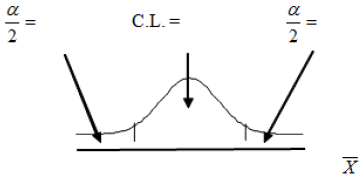
(iii) Calculate the error bound. (Round your answer to two decimal places.)
2. A sample of 12 small bags of the same brand of candies was selected. Assume that the population distribution of bag weights is normal. The weight of each bag was then recorded. The mean weight was 3 ounces with a standard deviation of 0.13 ounces. The population standard deviation is known to be 0.1 ounce.
NOTE: If you are using a Student’s t-distribution, you may assume that the underlying population is normally distributed. (In general, you must first prove that assumption, though.)
Find the following. (Round your answers to two decimal places.)
(i)x =
(ii)σ =
(iii)sx =
Which distribution should you use for this problem? (Round your answers to three decimal places.)
X -~
Construct a 90% confidence interval for the population mean weight of the candies.
(i) State the confidence interval. (Round your answers to three decimal places.)
|
,
|
(ii) Sketch the graph.
(iii) Calculate the error bound. (Round your answer to three decimal places.)
Construct a 98% confidence interval for the population mean weight of the candies.
(i) State the confidence interval. (Round your answers to three decimal places.)
|
,
|
(ii) Sketch the graph.
(iii) Calculate the error bound. (Round your answer to three decimal places.)
3. A pharmaceutical company makes tranquilizers. It is assumed that the distribution for the length of time they last is approximately normal. Researchers in a hospital used the drug on a random sample of 9 patients. The effective period of the tranquilizer for each patient (in hours) was as follows: 2.7; 2.9; 3.1; 2.3; 2.3; 2.2; 2.8; 2.1; and 2.4.
NOTE: If you are using a Student’s t-distribution, you may assume that the underlying population is normally distributed. (In general, you must first prove that assumption, though.)
(i) Round your answer to two decimal places.
x =
(rounded to two decimal places)
(ii) Round your answer to two decimal places.
sx =
(rounded to two decimal places)
(iii) Enter an exact number as an integer, fraction, or decimal.
n =
(iv) Enter an exact number as an integer, fraction, or decimal.
n − 1 =
Which distribution should you use for this problem? (Enter your answer in the form z or tdf where df is the degrees of freedom.)
Construct a 95% confidence interval for the population mean length of time.
(i) State the confidence interval. (Round your answers to two decimal places.)
|
,
|
(ii) Sketch the graph.
(iii) Calculate the error bound. (Round your answer to two decimal places.)
5. When designing a study to determine this population proportion, what is the minimum number of drivers you would need to survey to be 95% confident that the population proportion is estimated to within 0.04? (Round your answer up to the nearest whole number.)
drivers
6. Suppose that insurance companies did a survey. They randomly surveyed 420 drivers and found that 340 claimed they always buckle up. We are interested in the population proportion of drivers who claim they always buckle up.
NOTE: If you are using a Student’s t-distribution, you may assume that the underlying population is normally distributed. (In general, you must first prove that assumption, though.)
(i) Enter an exact number as an integer, fraction, or decimal.
x =
(ii) Enter an exact number as an integer, fraction, or decimal.
n =
(iii) Round your answer to four decimal places.
p’ =
(rounded to four decimal places)
Which distribution should you use for this problem? (Round your answer to four decimal places.)
P’ ~
|
,
|
Construct a 95% confidence interval for the population proportion who claim they always buckle up.
(i) State the confidence interval. (Round your answers to four decimal places.)
|
,
|
(ii) Sketch the graph.
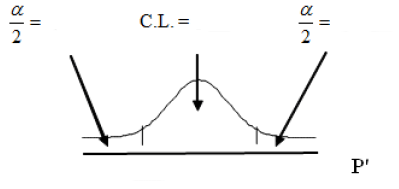
(iii) Calculate the error bound. (Round your answer to four decimal places.)
7. According to a poll, 86% of California adults (435 out of 506 surveyed) feel that education is one of the top issues facing California. We wish to construct a 90% confidence interval for the true proportion of California adults who feel that education is one of the top issues facing California.
What is a point estimate for the true population proportion?
8.A quality control specialist for a restaurant chain takes a random sample of size 15 to check the amount of soda served in the 16 oz. serving size. The sample mean is 13.50 with a sample standard deviation of 1.54. Assume the underlying population is normally distributed.
Find the 95% confidence interval for the true population mean for the amount of soda served. (Round your answers to two decimal places.)
|
,
|
9.Stanford University conducted a study of whether running is healthy for men and women over age 50. During the first eight years of the study, 1.5% of the 451 members of the 50-Plus Fitness Association died. We are interested in the proportion of people over 50 who ran and died in the same eight-year period.
NOTE: If you are using a Student’s t-distribution, you may assume that the underlying population is normally distributed. (In general, you must first prove that assumption, though.)
Which distribution should you use for this problem? (Round your answers to four decimal places.)
P’ ~
|
,
|
|
"You need a similar assignment done from scratch? Our qualified writers will help you with a guaranteed AI-free & plagiarism-free A+ quality paper, Confidentiality, Timely delivery & Livechat/phone Support.
Discount Code: CIPD30
Click ORDER NOW..